REVIEW · SAN FRANCISCO
San Francisco Self-Guided Audio Drive: Explore at Your Own Pace
Book on Viator →Operated by Adventures with Action · Bookable on Viator
San Francisco is best when you can move at your own speed. This audio-driven drive gives you a hands-free way to learn the city while you’re behind the wheel. You get a simple route, location-triggered stories, and the kind of stops that turn a normal sightseeing loop into a smart overview of the city.
Two things I really like: the tour is offline after download, so you’re not stuck hunting for signal, and the access is lifetime with no expiry. It also works well for families because you can pause for snacks, bathrooms, and quick photo breaks without messing up the day.
The main thing to consider is that you’re doing this in real SF traffic, and it’s self-guided—so if you miss a turn or the next stop is tricky to pull over for, there’s no in-person guide to fix it on the spot.
In This Review
- Quick hits before you start
- How the SF audio drive actually works
- Entering SF at Alamo Square: Painted Ladies, then City Hall
- What to watch for
- Lombard Street and Telegraph Hill: the fun, the views, and the caution
- Practical tip
- Coit Tower and the housing story: viewpoint plus context
- Chinatown by car: murals, the glass pyramid, and Dragon Gate
- Chinatown note
- Embarcadero to Ferry Building, then Union Square
- Why this middle stretch is valuable
- Fisherman’s Wharf to Crissy Field: the Golden Gate starts early
- What to plan for
- Driving across the Golden Gate and ending at the View Point
- A smart way to end your day
- Value: what you’re really buying for $16.99
- Who this drive is best for
- Should you book this San Francisco audio drive?
- FAQ
- FAQ
- What is the duration of the San Francisco self-guided audio drive?
- How much does it cost?
- What language is the tour offered in?
- Does it work offline?
- Do I need attraction tickets or reservations?
- Is there a live guide during the tour?
- Where does the tour start and end?
- What device do I need to use the app?
- How do I set up the audio in my car?
Quick hits before you start
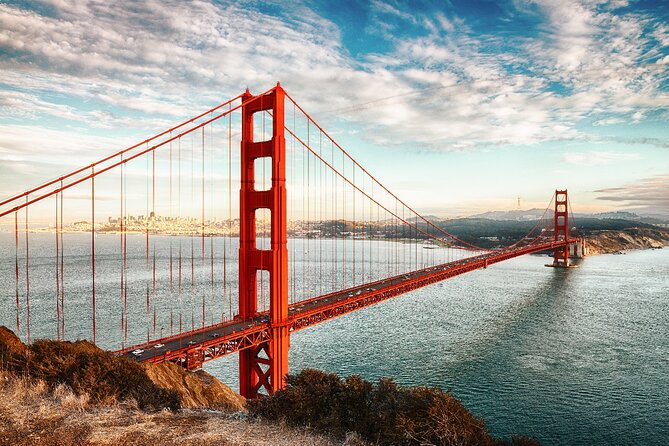
- Offline audio and maps after you download in strong signal, so the drive stays smooth.
- Location-triggered stories: the audio plays when you reach each point, so you’re not stuck tapping your phone.
- One purchase per vehicle: great value if you’re traveling with a car full of people.
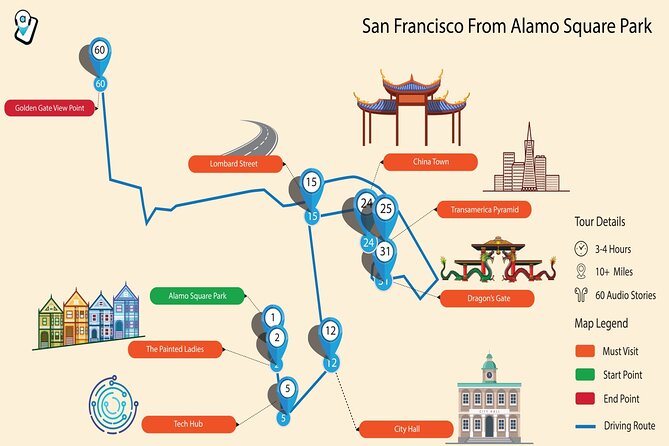
- A long route for a short day: about 17+ miles and 43+ audio stories in roughly 3–4 hours.
- Real-world SF variety: famous views, Chinatown details, and the Golden Gate crossing in one flow.
- You control the pacing: start anytime, pause anywhere, and come back later with your lifetime access.
How the SF audio drive actually works
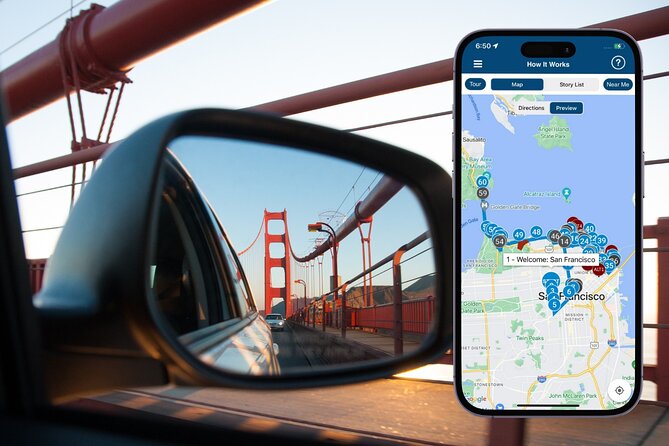
This isn’t a guided bus route. It’s a self-guided driving experience using Action’s Tour Guide App. After you book, you’ll get an email and a text with setup instructions and a password. You’ll also need to download the tour while you’re on strong Wi‑Fi or cellular, since the experience works offline afterward.
Once you’re at the start point, you open the app and launch the tour for your planned starting direction. Then you begin at the first story point. From there, the audio cues play automatically as you move along the route, so you can focus on driving and spotting landmarks instead of constantly checking your screen.
You also get a key practical advantage: you can start and stop as you like. That matters in San Francisco, where parking is not always friendly and timing can get weird fast. If you see a line for something, or traffic snarls, you can pause and regroup.
One more practical note: the tour is designed primarily for driving. It can include an optional walk section in Chinatown, but the overall rhythm assumes you’re moving between stops by car.
You can also read our reviews of more guided tours in San Francisco



Entering SF at Alamo Square: Painted Ladies, then City Hall
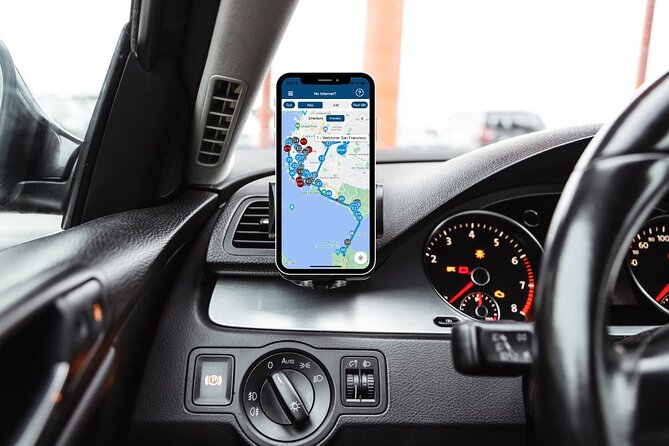
The tour starts at Steiner Street, Alamo Square Park. If you’ve ever seen photos of San Francisco’s Painted Ladies, this is your first real moment of recognition—big color, classic Victorian look, and instant “I’m here” energy.
From there, the drive turns into a story-driven orientation of what SF is and how it got shaped: past, present, and the push-pull of what’s changing. You’ll get the basics so later stops make more sense, instead of just being a list of famous places.
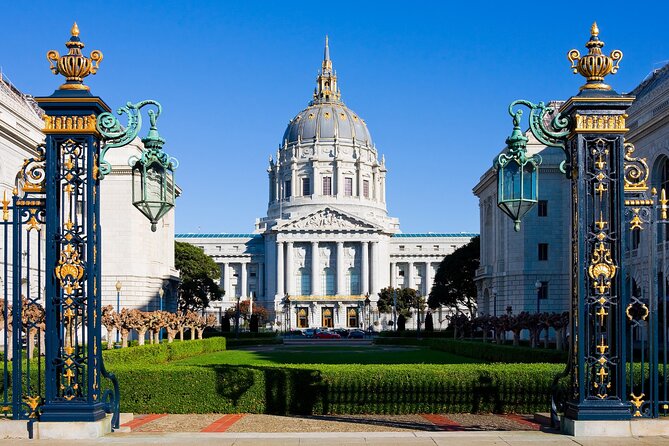
The route then swings past San Francisco City Hall, a massive marble landmark that’s easy to spot and hard to ignore. The audio explanation focuses on why the city grew and what that growth looked like in the early days. Even if you already know SF basics, I like how it gives you a clean framework before you go hunting for the more specific landmarks like Lombard Street.
What to watch for
Because this is self-guided, your success depends on syncing your driving with the app’s location cues. Plan to drive at a sensible pace and avoid rushing between stops—you’re covering more than 17 miles, and pull-over spots can be limited at peak times.
Lombard Street and Telegraph Hill: the fun, the views, and the caution
Next up is Lombard Street, the legendary one-block stretch famous for its eight hairpin turns. This is the moment where you’ll see why the road is such a global icon. It’s also the moment where you must slow down and stay alert. The audio nudges you to drive carefully, and that’s not just a vibe—it’s because this is a busy tourist area and the road is literally built for tight turns.
If you’re the type who likes photos, this is a great section to aim for when you can get a quick view without blocking traffic. If you’re stuck in slow-moving congestion, don’t try to force a perfect shot. Use the moment for the story first, then grab photos where it’s safe.
After Lombard, the tour heads toward Telegraph Hill. This is one of those SF hills where the reward is the view. You’ll be looking toward the bay and the city skyline once you’re up there. It’s a simple stop in theory, but it’s a big deal visually, and it helps connect the dots between the city’s geography and the way neighborhoods spread.
Practical tip
This is where you’ll feel the difference between an audio guide and a live guide. With a live person, you might get help with timing or where to park. Here, you’ll rely on the route and your own instincts—so give yourself a little extra buffer.
You can also read our reviews of more tours and experiences in San Francisco




Coit Tower and the housing story: viewpoint plus context
From Telegraph Hill, the drive climbs toward Coit Tower for another above-the-city look. The audio section pairs that view with a topic that’s very much about today: rapid real estate growth and the housing crisis.
That pairing is smart. You’re not just looking at SF from above. You’re hearing a reason why what you’re seeing matters—density, change, and what it means when a city’s desirability collides with housing realities. Even if you don’t love policy talk, the viewpoint makes the story feel grounded instead of abstract.
And yes, you’ll likely want a few photos from up there. I’d treat this stop as a “look, listen, breathe” moment rather than a stopwatch stop.
Chinatown by car: murals, the glass pyramid, and Dragon Gate
The tour then shifts into Chinatown, one of SF’s most active neighborhoods. The audio focuses on the impact of Chinese and Asian immigrants on San Francisco, so the stop isn’t just about shopping streets and food counters—it’s about why these streets exist and what shaped them.
Along the way, you pass a strange visual landmark: a huge glass pyramid. It’s exactly the kind of oddball sight SF is known for, and the audio fills in the story as you go by. Then you hit several Chinatown icons by car, including the Chinatown Mural and the Old Chinese Telephone Exchange.
Here’s where you get a choice: the tour lets you jump out for an optional walk in the neighborhood to explore foods, drinks, and desserts. This is a genuinely useful feature, because Chinatown is the kind of place where the best learning often happens while you’re moving around, not while you’re parked.
As you leave Chinatown, you drive through the Dragon Gate, described as a south-facing gate at the intersection of Bush Street and Grant Avenue. The audio also ties in another SF signature: the cable car, which you’ll hear about as you head toward the waterfront.
Chinatown note
Pulling off for parking and walking is the one part of a driving tour that can turn into a slow puzzle. If you want the walk, plan time for it. If you don’t, stay in the car and let the route cues guide you through the highlights.
Embarcadero to Ferry Building, then Union Square

Once you head toward the waterfront, the stories shift to SF’s maritime side and the city’s literal gold-digging past. That sets you up for the Embarcadero area, where the waterfront vibe makes everything feel more real.
From there, you reach Ferry Building for an important “nearly-famous-everyone-knows-it” moment. The audio section ties the waterfront directly to the Golden Gate Bridge story, including how it almost didn’t exist. If you’ve heard bridge trivia before, you’ll still likely pick up a few details you missed.
Then the route continues to Union Square, centered around a historic core with the Dewey Monument and the surrounding theaters. You get a sense of Union Square as a mixing point: art, shops, cafes, and SF’s habit of layering different kinds of city life in close distance.
Why this middle stretch is valuable
A lot of self-guided city tours jump from landmark to landmark with no glue. This one uses maritime history and civic context to help you connect the neighborhoods you’re seeing.
Fisherman’s Wharf to Crissy Field: the Golden Gate starts early
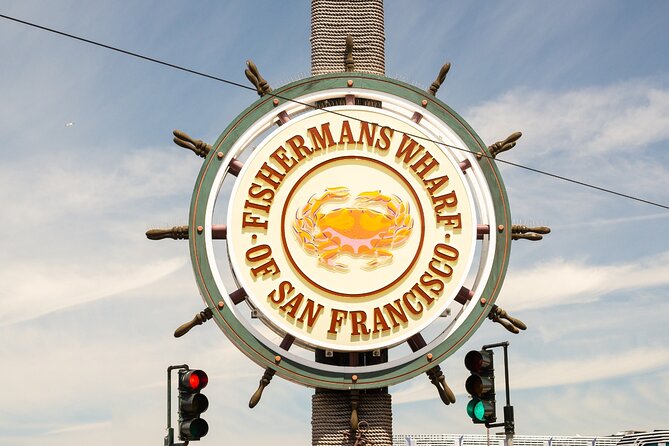
After Union Square, the tour guides you toward Fisherman’s Wharf, where you get your first strong sight of the Golden Gate Bridge. The audio story focuses on the many problem-solving hurdles behind the bridge: money issues, construction problems, aesthetic concerns, engineering challenges, even life-safety obstacles during building.
That’s a good way to prep yourself before you actually drive across. When you get to the viewpoint spots, you’ll understand why the bridge feels like it belongs to the city rather than being just another piece of infrastructure.
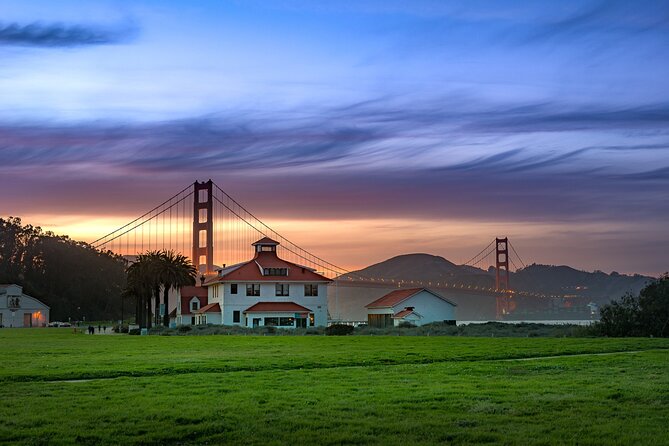
Then you pause at Crissy Field for phenomenal Golden Gate views. This audio segment explains why the Golden Gate Bridge is red, what its opening week was like, and why it became the modern transportation marvel it is today.
What to plan for
Golden Gate viewpoints are beautiful, but they also attract crowds. If you’re going for photos, arrive when you can and expect some slowdowns. If traffic is heavy, don’t panic. Pause the tour in the app and use that time to regroup.
Driving across the Golden Gate and ending at the View Point
Now comes the big cinematic payoff: the tour has you cross the bridge. You’ll pass by the Golden Gate Welcome Center on the way over, and the audio gives you the bridge’s construction history again, but now with the advantage of being right there in the action.
This is also a Hollywood favorite setting, and the audio nods to how often this bridge shows up in films and TV. Whether you care about Hollywood or not, the point is clear: the Golden Gate Bridge is not shy about being iconic.
After you cross, the tour continues your SF orientation with cultural and tech stops:
- SFMOMA (San Francisco Museum of Modern Art) is mentioned as a modern and contemporary art museum and the first West Coast museum devoted solely to 20th-century art.
- Then you get a tech angle: San Francisco as a technology hub, with references to Uber and Twitter headquarters.
The audio ends with a scenic finish at the Golden Gate View Point on the other side of the bridge.
A smart way to end your day
If you still have energy after the audio ends, use the extra time to walk a bit near the viewpoint. The tour is timed for a drive, but this ending is the kind where your eyes will want to keep exploring even after the narrator stops.
Value: what you’re really buying for $16.99
The price is listed as $16.99 per person, but the savings tip is the big deal: you purchase access per vehicle. That’s a huge difference if you’re traveling with a group. Instead of paying a seat-by-seat fee like a bus tour, you’re buying one listening experience for whoever is in your car.
Compared with guided tours, your value comes from control. You’re not locked into a schedule, you’re not waiting for a group, and you’re not paying for the privilege of sitting still. You can keep moving when you want to, pause when you need to, and revisit the same route later with the lifetime, no-expiry access.
The best part is that you’re not paying for tickets you might skip anyway. The tour is designed around free stops. It also doesn’t include attraction passes or timed reservations, so you’re free to decide what you want to do on the day.
Who this drive is best for
This audio drive works best if you like the mix of structure and freedom.
You’ll probably enjoy it if:
- You want a “SF primer” that hits major neighborhoods fast
- You’d rather drive than join a group bus
- You travel with family and want the option to pause for breaks
- You prefer audio storytelling instead of reading signs while stuck in traffic
It may be less ideal if:
- You hate driving in crowded areas
- You’re expecting perfect turn-by-turn navigation assistance every second
- You need constant hands-on help, since there’s no in-person guide
That’s not a flaw in the concept. It’s just how self-guided tours behave in the real world.
Should you book this San Francisco audio drive?
Book it if you want an easy, flexible way to learn SF and see a lot without paying for guides, buses, or separate entry fees. The offline capability, automatic audio cues, and the fact that you can replay the tour on future trips make it a strong value, especially if you’re sharing the ride with others.
Pass or consider another option if you’re the kind of traveler who needs step-by-step support and zero uncertainty. Self-guided means you handle the details—where to park, when to pull over, and how to stay aligned with the route during traffic.
FAQ
FAQ
What is the duration of the San Francisco self-guided audio drive?
It takes about 3 to 4 hours to complete, depending on your pace and stops.
How much does it cost?
The price is $16.99 per person, and there’s a savings tip that you purchase per car so the group cost can be lower than paying per individual on some tours.
What language is the tour offered in?
The tour is offered in English.
Does it work offline?
Yes. You’ll download the tour while you’re in strong Wi‑Fi or cellular, and then it works offline afterward, including offline maps.
Do I need attraction tickets or reservations?
No. The tour does not include attraction passes, entry tickets, or reservations.
Is there a live guide during the tour?
No. This is self-guided, and there is no in-person guide.
Where does the tour start and end?
It starts at Steiner Street, Alamo Square Park (Steiner St, San Francisco) and ends at the Golden Gate Bridge (Golden Gate Brg, California).
What device do I need to use the app?
You’ll need a smartphone or tablet with GPS connectivity. The recommended devices are an iPhone running iOS 15 or later, or an Android device version 9 or later, or an iPad/tablet with GPS and cellular connectivity for navigation.
How do I set up the audio in my car?
You connect your phone to your car stereo using Bluetooth, USB, or AUX. Audio playback is compatible with Apple CarPlay, and if that’s not working in your setup, using Bluetooth/USB/AUX or your phone speakers is the reliable fallback.
If you want, tell me your travel dates (or month) and whether you’re driving yourself or using a rental. I can suggest a smart start-time strategy so you spend more time enjoying stops and less time stuck.