REVIEW · SAN FRANCISCO
San Francisco Technology and History Tour: South of Market
Book on GetYourGuide →Operated by Heck Wes Tours · Bookable on GetYourGuide
SoMa tells stories fast. This guided 70-minute tour strings together South Park startup roots and Salesforce Terminal rooftop views, with a guide named Wes who makes the city’s tech glow feel grounded in real place. I especially like the way the tour connects modern-company names to earlier eras you’d never guess were here. One thing to consider: it’s a steady walking pace with a handful of short stops, so if you want long photo sessions or museum-style time, you may wish for more breaks.
South of Market is also one of San Francisco’s flattest areas, and this walk is wheelchair accessible. You’ll start with a shaded South Park intro, then move along major corridors like 2nd Street and end downtown with easy transit options.
In This Review
- Key Things I’d Watch For On This SoMa Tour
- SoMa Tech and History in 70 Minutes: What You Really Get
- South Park: Where Venture Capital Lives on a British-Style Square
- The 2nd Street Corridor: Shipping History That Explains Today’s Business Address
- Yerba Buena Gardens: Urban Renewal, Displacement, and Political Fallout
- Around Folsom Street: Famous Queer History in the Same Tech Frame
- Salesforce Terminal Rooftop Garden: Tar Flat to Skyline Views
- Pace, Accessibility, and What to Bring
- Price and Value: Why $30 Feels Fair Here
- Who This Tour Fits Best
- Should You Book the San Francisco Technology and History Tour: South of Market?
- FAQ
- How long is the tour?
- Where does the tour start and end?
- Is the tour wheelchair accessible?
- Is South of Market flat enough to be comfortable walking?
- Is there an option for a private group?
- What language is the tour guide using?
- What should I bring?
- Are there extra fees during the tour?
- FAQ
- Can I get a full refund if I cancel?
- Does the tour include a live guide?
Key Things I’d Watch For On This SoMa Tour
- South Park, from British-square roots to tech offices in the 2010s
- 2nd Street’s shipping link to the Pacific Mail Steamship Company docks
- Big-picture urban renewal at Yerba Buena Gardens and what displacement did to politics
- California High Speed Rail shown as part of SoMa’s future planning
- Salesforce Terminal built over a former beachfront natural gas refinery and once Tar Flat
- Klockar’s blacksmith as a quiet nod to early metalworking
SoMa Tech and History in 70 Minutes: What You Really Get
This tour is built like a good city story: short chapters, lots of cause-and-effect. You’re not just hearing dates. You’re learning how San Francisco keeps reinventing the same space—sometimes with better results, sometimes with real damage.
The best part is that it doesn’t treat tech as a separate universe. In SoMa, you’ll see how venture capital, shipping infrastructure, and housing politics all share the same streets. And because South of Market is flatter than most of the city, the walking feels manageable—even with a wheelchair.
At $30 per person for a 70-minute guided walk, the value comes from the way context stacks up. Instead of using your time on generic landmarks, you’re getting a guided map of how the neighborhood became the startup capital story people tell today—and what happened to make it possible.
You can also read our reviews of more historical tours in San Francisco



South Park: Where Venture Capital Lives on a British-Style Square
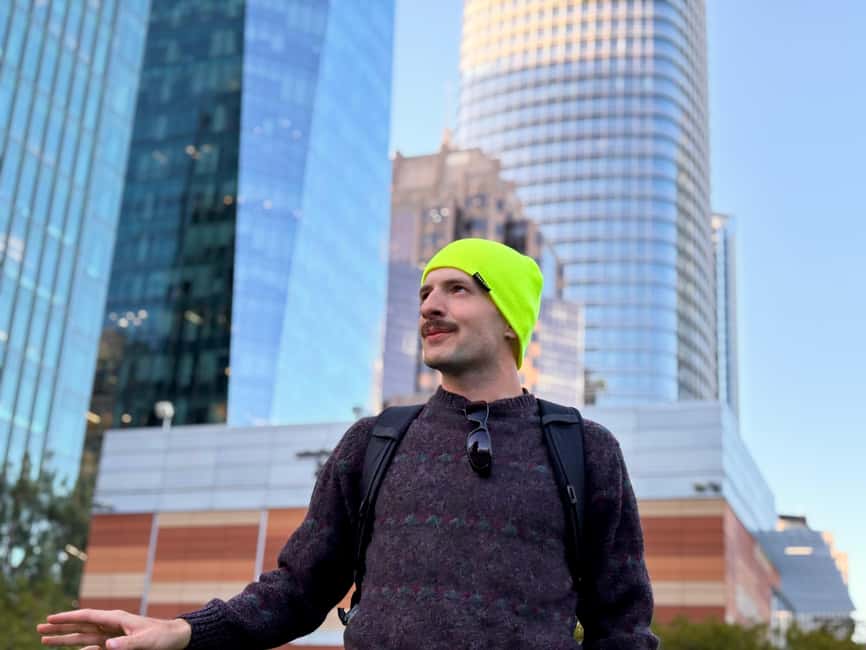
You begin in South Park, an older neighborhood anchored by a design inspired by a British garden square from the 1850s. That detail matters. It explains why this area has always been a “center” space—an organized pocket people could build around.
Wes, who lives and works in the neighborhood, brings that history to life with personality. I like the way he doesn’t treat South Park like a static backdrop. He frames it as a repeated stage for San Francisco’s big swings: gold rush camps, luxury development during the Gilded Age, and a refugee camp after the 1906 earthquake.
Then he brings you into the more familiar era. In the 2010s, South Park housed early offices of companies like Instagram and Twitter. That’s the headline version. The tour adds the footnotes: South Park also held a Japanese community, an industrial community, and the older working neighborhoods that came before the finance-tech era.
Practical upside: South Park has seating and shade, and you’ll spend about 10–15 minutes here before walking north. It’s a nice reset before the street-crossing portion starts.
The 2nd Street Corridor: Shipping History That Explains Today’s Business Address
Next you move along 2nd Street, and it’s one of those streets that sounds boring until someone explains why it’s important.
Here’s the key idea: 2nd Street connected downtown to docks tied to the Pacific Mail Steamship Company. In the 1800s and early 1900s, that kind of linkage wasn’t “nice to have.” It determined where money, jobs, and growth could flow.
The tour also points out something dramatic about how the ground changed. 2nd Street was part of the city’s early large land reclamation projects, where one of San Francisco’s largest hills was flattened to create space for the commercial thoroughfare. It’s a reminder that downtown doesn’t just “exist.” It’s been engineered again and again.
Then you get a present-day tech layer. Along the route you’ll see major company presence, including LinkedIn and DoorDash, and you’ll also hear about Anthropic. The point isn’t name-dropping. It’s learning why people want to be here—because the infrastructure decisions of the past still shape what’s practical today.
Walking note: the tour is designed to be mostly flat, and South of Market is famous for that. If you’re coming with mobility needs, this is one of the easier neighborhoods to handle on foot.
Yerba Buena Gardens: Urban Renewal, Displacement, and Political Fallout
At Yerba Buena Gardens, the tour shifts from street history into the kind of urban change that still affects the city’s politics.
You’re seeing the site of San Francisco’s largest Urban Renewal projects. That’s not just a “development” fact. It’s a human one. Wes explains who lived there and what eviction did to the neighborhood’s community fabric.
This stop is where the tour becomes more than sightseeing. The conversation turns to how displacement doesn’t vanish when bulldozers stop. It can reshape who has power, which voices get heard, and what people demand next.
It’s also a good checkpoint for your own thinking. You’ll look at a landscaped urban space and you’ll learn to ask: What did this replace? Who got pushed out? And what changed in the city’s decision-making because of it?
If you’re the type who likes history with consequences—not just trivia—this is the part you’ll remember.
Around Folsom Street: Famous Queer History in the Same Tech Frame
As you continue moving, the route also threads through Folsom Street, known for its LGBTQ history. The tour uses this corridor to show how the neighborhood has held multiple identities over time, not one clean storyline.
In a place like SoMa, that matters. Tech is now the headline. But street-level life has always included culture, community, and politics happening side by side with business.
This section is also a reminder that tech doesn’t wipe the city clean. It overlays. Sometimes it overwrites. Sometimes it changes the pressure on the streets. You’ll get a better feel for that tension here than from a one-stop “viewpoint only” tour.
You can also read our reviews of more shopping tours in San Francisco
Salesforce Terminal Rooftop Garden: Tar Flat to Skyline Views
The tour ends near Market Street at the rooftop garden at Salesforce Terminal. If you like practical payoffs—views, fresh air, a clear end-point—this works.
From the rooftop garden you get skyline and Bay views. It’s a good finish because you can stand back, look outward, and connect what you heard to what’s in front of you. You’re not just walking; you’re learning how SoMa turned into a global-symbol district.
And this part comes with honest context. The Salesforce project is described as the most visible tech imprint on San Francisco, and it’s also the city’s largest recent development. But it wasn’t built on a blank stage.
The site was built over a beachfront natural gas refinery. It was once home to Tar Flat, described as the city’s poorest neighborhood. That layering—industry, low-income housing, environmental cleanup, then corporate scale—helps you understand why this area feels like both progress and contradiction.
There’s also a small stop that adds texture: Klockar’s blacksmith, which acts like a reminder of early metalworking and the neighborhood’s working past. It’s the kind of detail that makes a place feel older than the current buildings.
Bonus logistics: when the tour is over, you’ll have easy access to BART and MUNI, and the Powell Street cable car is about a 15-minute walk away. That’s great if you want to keep exploring right after.
Pace, Accessibility, and What to Bring
This is a 70-minute guided walking tour. You’ll start with a short South Park intro, then spend the rest of your time moving along city corridors.
The good news for comfort: South of Market is the flattest neighborhood in San Francisco, and the tour is designed to be wheelchair accessible. Seating and shade exist at South Park, which helps at the start.
What to bring is simple:
- Comfortable shoes
- Comfortable clothes
If you’re sensitive to sun, plan for it. Downtown can feel bright, even on cooler days. South Park gives you shade early, but the rest of the walk is still outdoors.
Price and Value: Why $30 Feels Fair Here
For $30 per person, you’re buying a guided narrative that connects multiple eras: gold rush encampments, Japanese community life, industrial work, early tech-office presence, shipping corridors, and modern high-profile development.
What makes the price feel fair is the density of ideas per minute. Many city walks cover “what you can see.” This one also helps you understand “why it looks like that now,” including major planning threads like the future path of California High Speed Rail.
You also get the sort of guide you want for a neighborhood like this. Reviews highlight Wes as someone who lives and works locally, knows the streets in a personal way, and can explain how the startup ecosystem works from the inside. That’s not just entertaining. It helps you interpret what you see without turning the walk into a lecture.
Who This Tour Fits Best
This is a strong fit if you:
- Want tech-San Francisco without the usual cookie-cutter stops
- Like urban history that explains why neighborhoods change
- Prefer guided walking over reading long articles
- Need a mostly flat route that’s wheelchair accessible
It may not be the best fit if you want:
- Long, unhurried sightseeing at each point
- A heavy museum or indoor focus
- A tour that pauses for deep photo time
Should You Book the San Francisco Technology and History Tour: South of Market?
Yes—if your goal is to understand SoMa as a working, changing district rather than a set of landmarks. The combination of venture capital roots, shipping-era streets, urban renewal impact, and an end-point rooftop view makes the walk feel like a complete story arc.
Book it especially if you’re visiting for a short time and want the “tech meets reality” version of San Francisco. And if you’re local, you’ll likely get that rare feeling of seeing familiar streets with new context—because this tour trains your eyes to notice what came before.
FAQ
How long is the tour?
The tour lasts 70 minutes.
Where does the tour start and end?
You start in South Park and end near Market Street at the Salesforce Terminal rooftop garden.
Is the tour wheelchair accessible?
Yes. The tour is listed as wheelchair accessible.
Is South of Market flat enough to be comfortable walking?
South of Market is described as the flattest neighborhood in San Francisco, and the walk is mostly flat.
Is there an option for a private group?
Yes. Private group options are available.
What language is the tour guide using?
The tour is guided live in English.
What should I bring?
Bring comfortable shoes and comfortable clothes.
Are there extra fees during the tour?
There are no obligatory additional fees listed.
FAQ
Can I get a full refund if I cancel?
Yes, the activity offers free cancellation up to 24 hours in advance for a full refund.
Does the tour include a live guide?
Yes, it’s a live tour with an English guide.